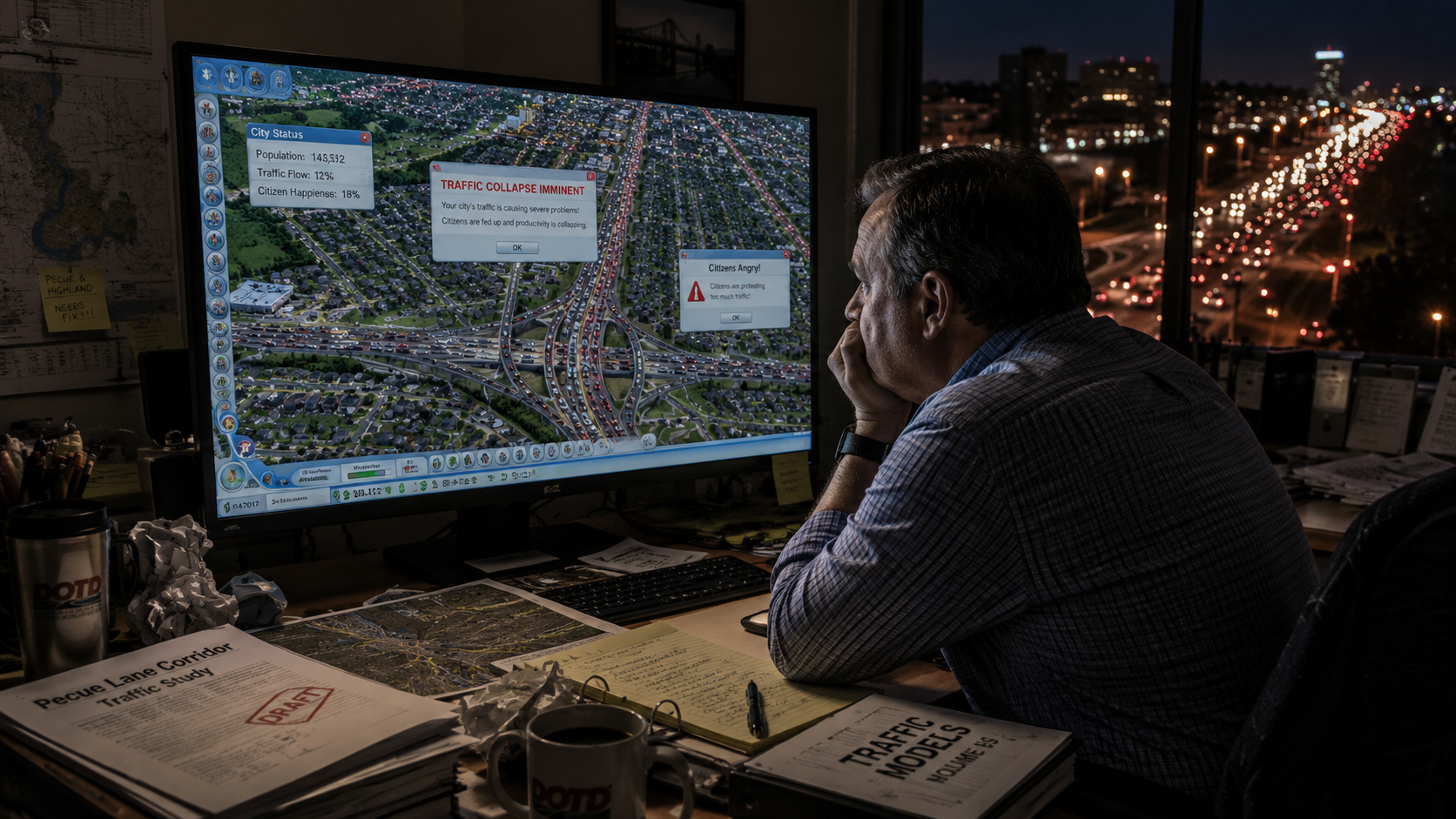
ST. GEORGE, LA – State and local traffic engineers confirmed Thursday that the entire Pecue Lane corridor was designed using SimCity on the “Maximum Difficulty” setting sometime around 2017, ultimately leading to Louisiana’s first-ever diverging diamond interstate interchange emptying directly into what residents now describe as “a two-mile live-action traffic stress simulator.”
Officials proudly celebrated the futuristic new interchange near I-10, calling it a revolutionary transportation achievement for Baton Rouge. Unfortunately, about one mile away sits the intersection of Pecue and Highland, which still operates as a two-lane, three-way intersection controlled by a single stop sign and the collective mercy of strangers.
Another mile down the road, drivers attempting to cross Airline Highway discovered the traffic signal timing still appears optimized for a period when Pecue Lane was mostly cows, trees, and one guy driving a tractor every few hours.
“We spent eight years preparing the diverging diamond itself,” explained one official while frantically clicking traffic icons on a laptop. “The possibility that thousands of cars would continue driving afterward honestly never came up.”
Residents say the entire corridor now feels less like an upgraded road and more like a FEMA evacuation route accidentally feeding into a Bass Pro Shops parking lot.
Traffic experts now estimate the average Baton Rouge child born today should reach the Pecue and Airline intersection sometime around their sophomore year of college.